Blog posts


The question retailers used to argue about — is retail media real, and does it belong in the physical store — has quietly answered itself. Global retail media spend is now measured in the tens to hundreds of billions, and the likes of Tesco, Walmart, Carrefour, Kroger, and in the Nordics S-Group and Kesko already run public retail media businesses. The category has moved. What most retailers haven’t done yet is build for where it actually lives: the store.
For most retailers, the physical store is the single largest concentration of customer attention and purchase intent they own. It is where customers arrive ready to buy, spend longer than on any digital surface, and make most of their category and brand decisions. Yet omnichannel strategies still routinely treat the store as an appendix of the digital plan — the place where the website’s promotions eventually get printed onto a shelf edge.
The playbook argues for inverting that hierarchy. Store-centric omnichannel puts the in-store moment at the center and uses digital, loyalty, email, and social as amplification layers — driving traffic to the store, surfacing offers the customer saw on a screen, closing the loop back into POS and loyalty. The audience is already there. The job is to build around it.
“The store should be the starting point — not an afterthought added to an e-commerce toolset. Strategies built for online retail media don’t translate to the physical environment.”
— Doohlabs, “Store in the Core”
Here is the part that quietly changes the economics. The data needed to target that in-store audience already exists inside the retailer: aggregated POS and loyalty signals that describe who shops which category, when, and in which locations — with no external sensors, no third-party data brokers, and no individual customer data in the media-sales flow at all.
That matters commercially as much as legally. Personal data stays in the retailer’s own systems; what the platform sells is access to audiences, not data. Advertisers buy a clean, well-defined media product — an audience, a footprint, a reach, a price — and never see an individual shopper behind it. First-party data has stopped being a privacy compromise and started being a strategic asset. And it compounds: more loyalty members produce richer signals, richer signals produce better-targeted media products, and more ad revenue funds the member benefits that grow the loyalty base.
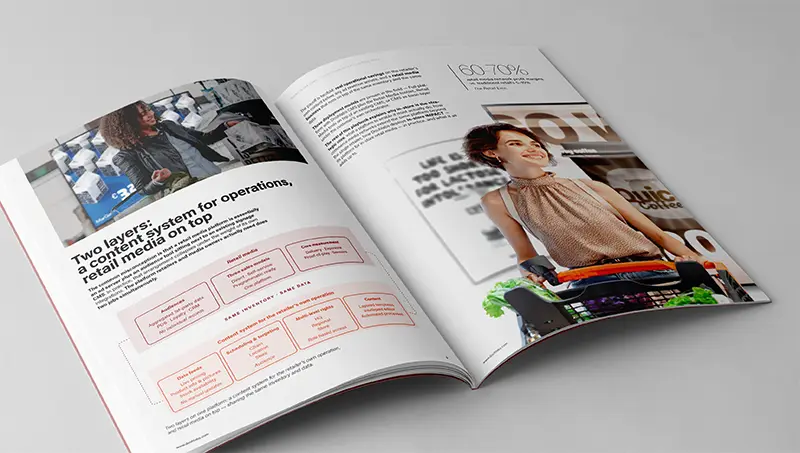
The catch is that you cannot run this on a signage CMS with an ad server bolted on the side. The platform a retailer or media owner actually needs does two jobs at once: it is a full-featured content system for the retailer’s own operation — automating thousands of campaigns and tens of thousands of creatives across every store, with live pricing flowing in from PIM — and it carries a retail media business on top of that same inventory and the same data.
The payoff is twofold. The content layer delivers real operational savings — fewer staff hours, faster rollout, fewer pricing errors on screen — before a single ad is sold. For most retailers, that layer alone pays for the platform. The media business then runs on top of it, not beside it.
INSIDE THE PLAYBOOK
Store is the core. The playbook is the blueprint for building there.
---
“Store in the Core” lays out what to build, how to deploy, and what it takes to win at in-store retail media — written for retailers and media owners.