Blog posts


In-store retail media is rapidly maturing from a collection of screens and placements into a strategic media channel with real commercial expectations. As investments grow and brands demand accountability comparable to online and off-site media, one question consistently rises to the surface: how do we measure impact inside the store in a way that is credible, scalable, and decision-ready?
Unlike digital environments, the physical store is complex. Shoppers move freely, attention is fragmented, and media exposure does not happen in neat, deterministic sequences. Yet the store remains the most influential moment in the shopper journey, where decisions are made and baskets are filled. Measurement, therefore, cannot be an afterthought—it must be foundational to how in-store retail media is designed, sold, and optimized.
At Doohlabs, we see in-store measurement best understood as a layered framework. Each layer answers a different strategic question, and together they create the basis for trust, comparability, and long-term growth in in-store retail media.
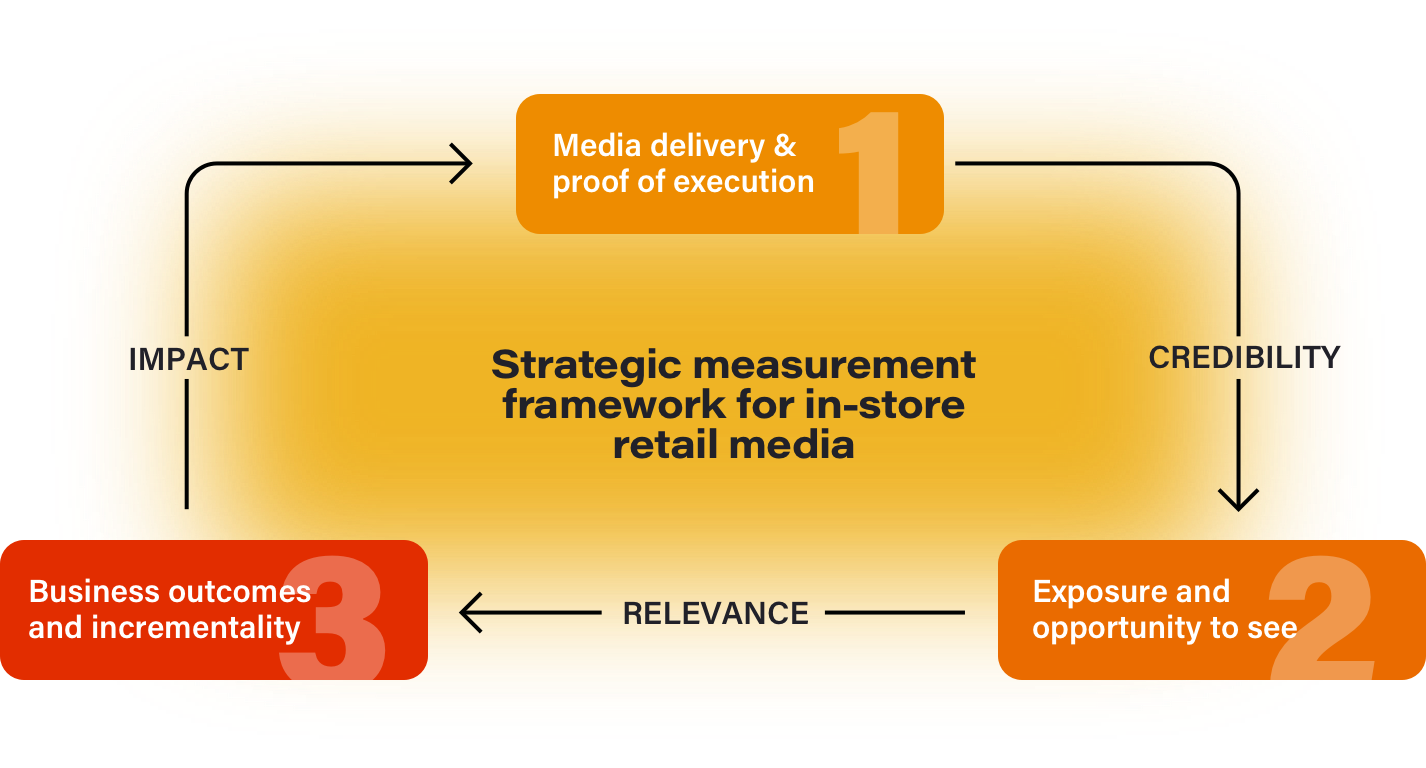
The first and most fundamental layer of in-store measurement is proving that media actually ran as planned. Before retailers and brands can discuss effectiveness or outcomes, there must be absolute clarity on delivery: what was shown, where, when, and how often.
In-store environments introduce operational realities that digital channels rarely face. Screens can be offline, stores may have local overrides, and campaigns often run across heterogeneous networks with varying hardware, layouts, and opening hours. Measurement at this layer establishes operational credibility by confirming impressions at the level of screens, stores, and time.
This layer is not about persuasion or performance; it is about accountability. It enables retailers to confidently invoice campaigns, assures brands that they received what they paid for, and provides a shared factual baseline for all stakeholders. Without reliable delivery measurement, any higher-level analysis becomes speculative.
Platforms like Doohlabs In-Store Impact are designed to make this layer systematic rather than manual, turning network complexity into structured, auditable data. As in-store retail media scales, this foundational layer becomes the bedrock on which everything else depends.
Once delivery is established, the next question becomes more nuanced: did shoppers actually have the opportunity to see the message? This second layer moves measurement closer to the shopper by connecting media delivery to store context and shopper presence.
Unlike online impressions, in-store exposure cannot be assumed simply because content was played. Visibility depends on factors such as screen placement, dwell time, store traffic patterns, and time of day. Measurement at this layer focuses on estimating opportunity to see, grounding media value in realistic exposure rather than theoretical reach.
This is where in-store retail media begins to align with broader media standards. By translating physical exposure into comparable metrics, retailers can start speaking the same language as brand media teams. It also allows networks to differentiate premium placements and justify pricing based on real shopper presence rather than screen count alone.
Strategically, this layer enables smarter planning. Retailers gain insight into which locations and formats truly deliver attention, while brands can make informed choices about where in the store their messages are most likely to matter.

The third layer is where in-store retail media proves its strategic value: linking exposure to business outcomes. Ultimately, brands invest in retail media not for screens or impressions, but for influence on sales, brand performance, and shopper behavior.
Measuring outcomes in-store is inherently complex. Shoppers may be exposed multiple times, across multiple channels, before purchasing. Attribution is rarely linear, and over-simplified models risk overstating impact. For this reason, outcome measurement must be approached with methodological discipline and transparency.
At this layer, the focus shifts from absolute attribution to incremental understanding. Did the campaign lift sales compared to a relevant baseline? Did it influence category performance, basket composition, or brand preference? These insights do not replace the earlier layers—they depend on them. Only when delivery and exposure are well understood can outcome analysis be trusted.
For retailers, this layer strengthens the strategic positioning of in-store retail media within the broader retail media mix. For brands, it provides the confidence needed to scale investment and integrate in-store activity into omnichannel planning.
Each of these layers serves a distinct purpose, but their real power emerges when they are connected. Delivery data without exposure lacks shopper relevance. Exposure without outcome risks becoming an academic exercise. Outcomes without solid foundations undermine credibility.
In-store retail media will not scale sustainably on promises alone. It requires shared measurement principles that align retailer operations, media sales, and brand expectations. A layered approach provides exactly that: clarity without oversimplification, and rigor without rigidity.
At Doohlabs, we believe that measurement is not just a reporting function—it is a strategic enabler. By structuring in-store measurement across these foundational layers, retailers can move faster, sell smarter, and build long-term trust in the channel.
As in-store retail media continues to professionalize, measurement will increasingly define winners and laggards. Retailers that invest early in robust, layered measurement frameworks will be better positioned to attract brand budgets, withstand scrutiny, and integrate in-store media into the wider retail media ecosystem.
The store is finally taking its place at the core of retail media strategy. Measurement is a critical part of it. Retailers are not required to build all layers at once, but to have a strategic plan for implementing them in stages is a major competitive advantage.