Blog posts


In this article, Hannaleena Koskinen (ReTALE, Aller Media Nordic) and Teemu Kurri (Doohlabs & Craneworks) share what is needed to run a successful retail media business and explain how joining an open multi-retailer network enables retailers and other companies with audiences that attract advertisers is the easiest way to start earning high-margin media revenue. With that the obvious benefit is to fund either core business or marketing investments.
A typical retail media network (RMN) is a retailer-established business entity that organizes media sales across the channels the retailer chooses to include — from onsite placements to in-store and CRM touchpoints. Building such a network is a complex, multi-stage effort that requires significant commercial, technological and operational resources.
An open retail media network operates differently. It is designed to bring together multiple retailers — and even companies from other consumer-facing industries with valuable audiences — under a shared commercial and technological framework. Rather than each organization building its own standalone RMN, they can join a broader ecosystem.
Unlike many traditional retail media models, an open network also expands the advertiser base. It is not limited to suppliers i.e. brands whose products are physically available on the retailer’s shelves. Service providers, financial services, travel companies and other consumer brands can participate — unlocking incremental demand and revenue that would otherwise remain untapped.
ReTALE together with its partners Doohlabs and Craneworks offers an alternative to building everything independently. The model not only enables retailers and media owners to start generating retail media revenue in weeks, but also provides the expertise required to design and scale an optimal retail media solution for each organization — maximizing revenue across every relevant channel.
Through an open retail media network, retailers gain access to professional commercial guidance, a proven technology platform for operating and measuring retail media, and hands-on support in building the capabilities required across channels. This includes the orchestration of media sales and campaign delivery, as well as the development of critical in-store infrastructure such as screen networks in physical stores and other customer-facing environments. And support in choosing the right retail media business model in relation to procurement processes.
Open network enables retail media for many kinds of companies:
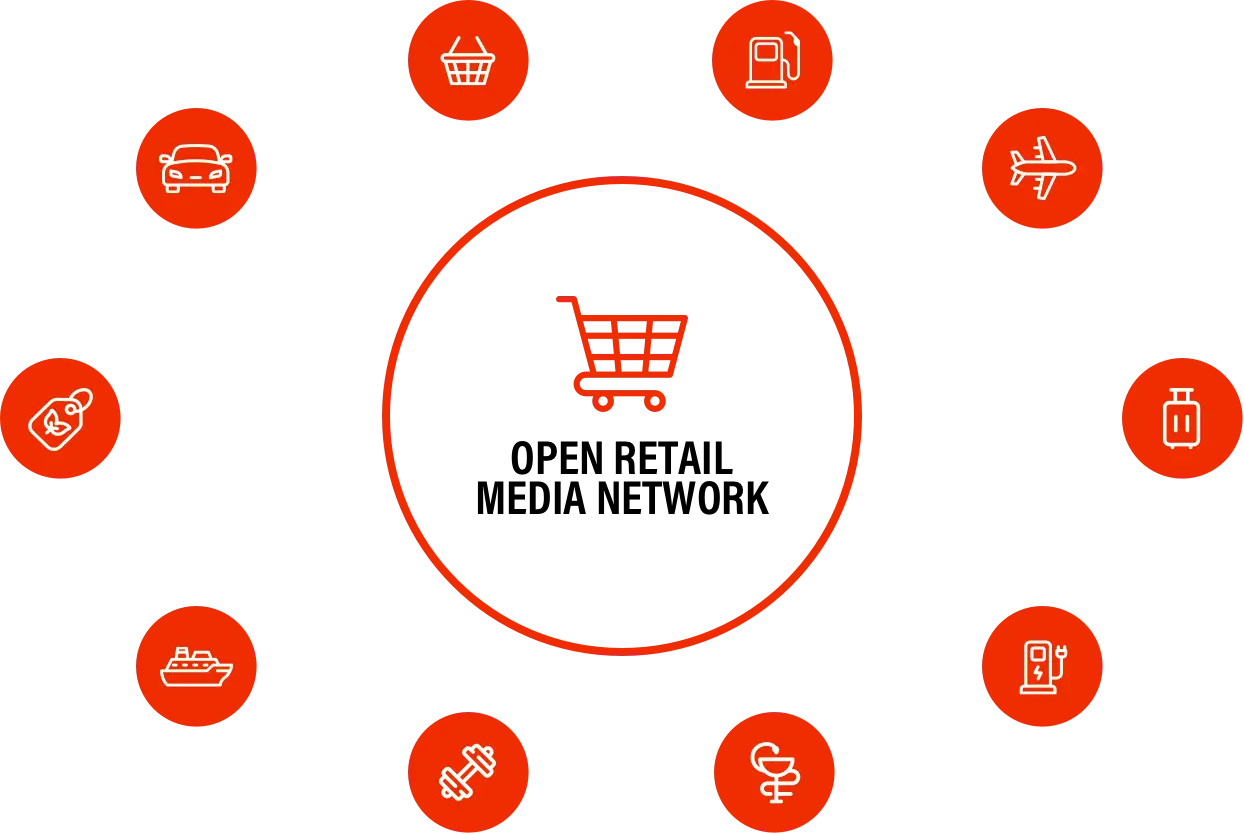
Open network enables creation of different types of verticals:
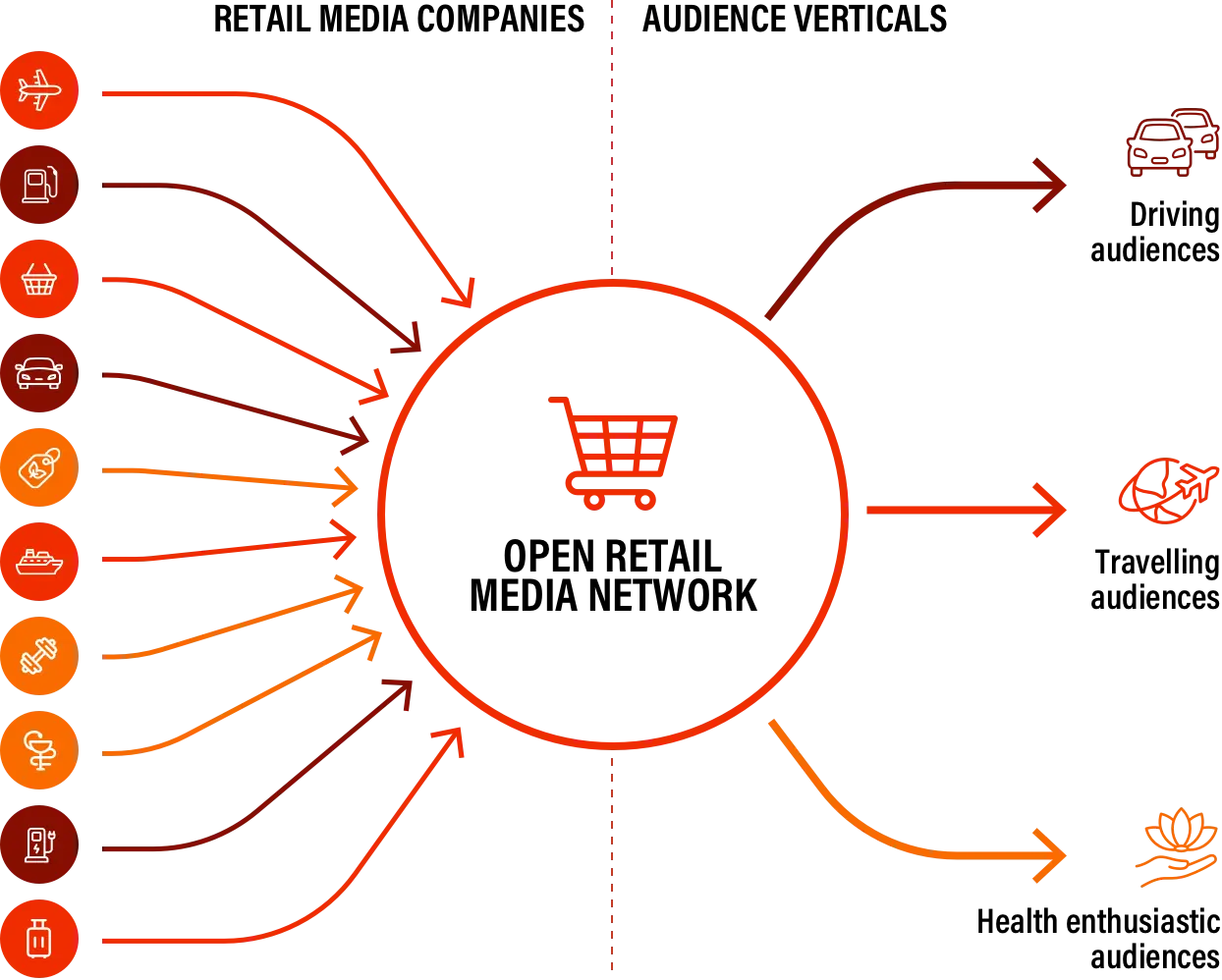
The verticals plus traditional retail media together are sometimes called also Commerce Media. For simplicity’s sake, we use only Retail Media in this article.
Hannaleena Koskinen from ReTALE explains: If you are a B2C company, could you possibly be a retail media in denial? Your various consumer touchpoints and audience data could be evaluated to understand the “size of the price” meaning the potential in entering high margin retail media business. Not only the high margin revenue, but also the possibility of adding value to your customers everyday life are important drivers to explore this opportunity.
Teemu Kurri from Doohlabs/Craneworks adds: Retail media has traditionally been seen as a playground for the largest retailers, mainly due to the significant investments required and the multiple organizational layers involved. Open retail media networks change this dynamic by making retail media accessible to a much broader range of businesses. With the platform infrastructure provided by the network, and campaign orchestration and media sales available as managed services, the barriers to entry are significantly lowered. In that sense, open networks truly democratize retail media.
What then is needed to build a successful retail media business? Running retail media is a combination of business know-how, retail media sales experience, advanced adtech and ability-to-execute. We can help you in every step of the way so that you can concentrate on what really counts, your core business.
Here is the most important learning you need to understand when entering retail media:
Retail media, in its current form, is roughly a decade old. Unlike traditional media channels, retail media owners are not primarily in the business of selling advertising — their core business is retail, commerce, or customer relationships.
That difference makes retail media structurally more complex to launch and operate. It requires a commercial model, sales capability, technology platform and operational processes that most retailers and media owners have not historically built in-house.
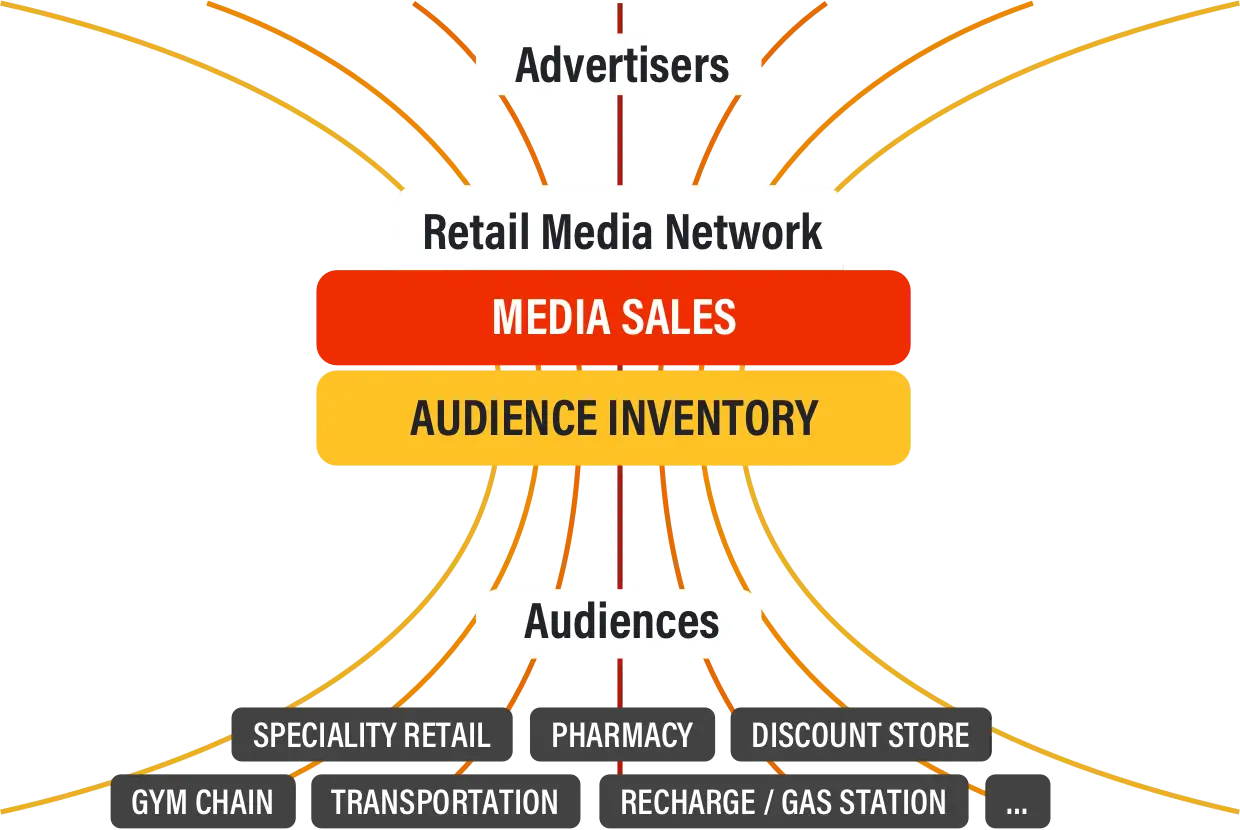
This is why many organizations choose not to build everything alone but instead join an open retail media network. In our model, ReTALE operates and commercializes the media offering, Doohlabs provides the technology platform that enables automation for campaign management and measurement, and Craneworks builds business-critical in-store media networks designed specifically for retail media use. And with Samsung as our hardware provider, we can reliably deliver even the largest in-store networks in a very short timeframe. Together, this allows retailers and other media owners to start generating revenue quickly — without having to construct the entire ecosystem from scratch.
Hannaleena: Of course, we must acknowledge that entering the retail media business is a strategic decision for any company. The size of the business case and the possibility of enhancing the customer experience are the key drivers. Other important drivers are the impact on company’s image as being in the forefront and the possibility of deepening commercial relationships with partners, such as advertisers, according to our recent survey (Retail Media Status & Trends 2025).
Teemu: Making strategic decisions also means defining your technology direction—whether to build everything in-house, partner with a trusted expert in key areas, or adopt a fully managed service model. Whatever path you choose, ensure you work with partners who have a deep understanding of retail media orchestration, have developed solutions that genuinely help retailers run and grow their media business, and can demonstrate a strong, proven track record.
Contrary to what the dominance of online retail media in the US might suggest, retail media is inherently an omnichannel business. Beyond onsite placements in a webstore or app, it includes in-store media, CRM channels such as email or text messages, digital coupons, loyalty ecosystems, customer magazines, and many other touchpoints across the customer journey.
In Europe, this omnichannel reality is even more pronounced. We estimate — conservatively — that for nine out of ten organizations where retail media is relevant, omnichannel retail media will generate more revenue than traditional onsite advertising alone.
Retailers can commercialize their entire omnichannel media ecosystem.
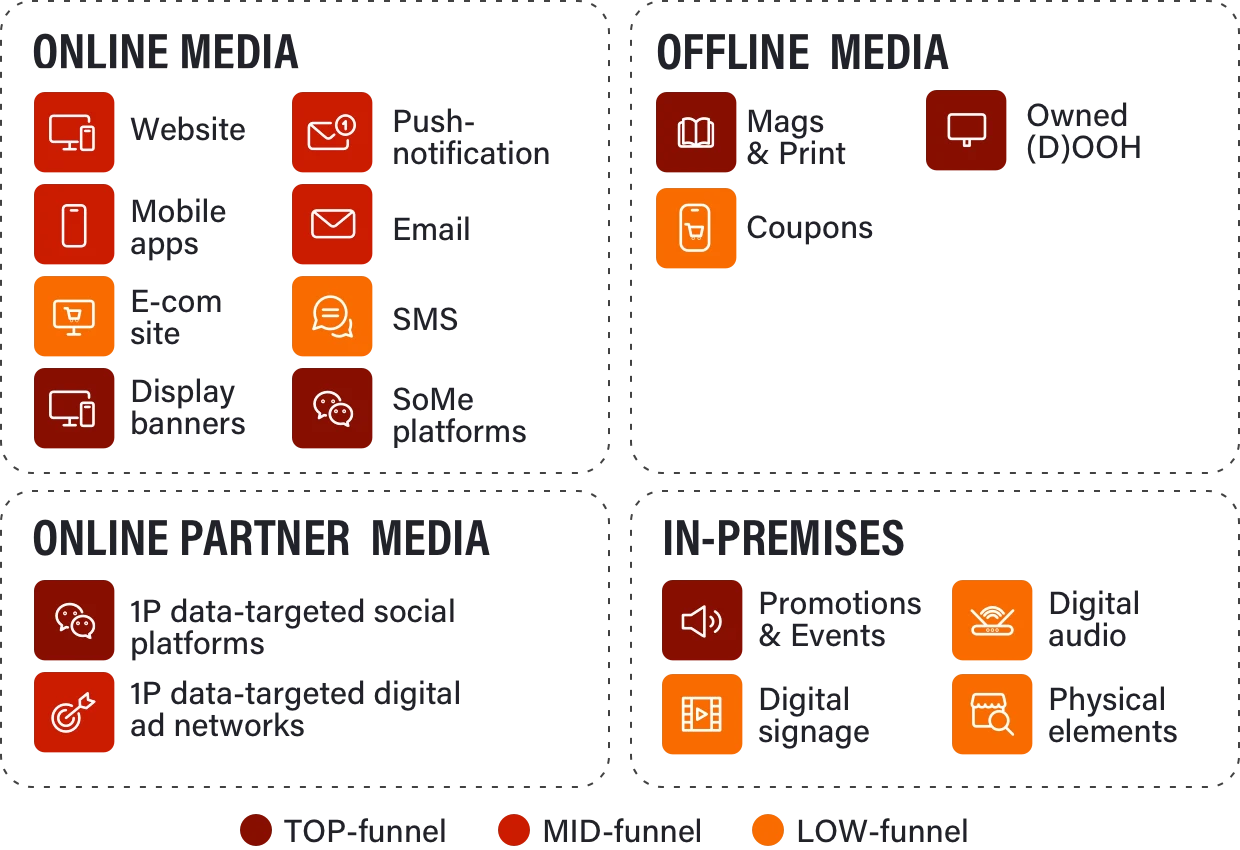
For larger retail chains in particular, in-store retail media is often the single most valuable channel. The reach is significant, the context is highly commercial, and advertisers consistently value the ability to influence decisions at the point of purchase. The business case has already been proven & tested in mature markets such as Finland, where in-store networks have been built and scaled for many years now already. For retailers joining our open retail media network today, this means they can benefit from that head start — leveraging proven infrastructure, operational know-how and established best practices rather than starting from scratch.
Hannaleena: Alongside the traditional media mix (channels & content) there is a high demand among advertisers for omnichannel data-driven concept, where you can be present at the point of purchase – where the buying intention is high. Retail media provides all that: versatile context and new kinds of audiences, having the possibility to measure the incremental sales uplift and effect on consumer base.
Teemu: Since in-store is at the core of retail media for most consumer-facing businesses, platforms designed for online retail media cannot effectively orchestrate it. Traditional digital signage systems are not optimal either, as they were built to publish and manage content—not audiences. A purpose-built in-store retail media platform is designed to automate audience creation, campaign management, and media sales processes, while supporting constantly evolving omnichannel customer journeys.
Retail media data sources:

First-party data is one of the cornerstones of retail media. The combination of customer insight and purchase context is precisely what makes the channel valuable to advertisers. Without it, retail media becomes just another media placement — lacking the relevance and commercial precision that defines the category.
Effective retail media is built on a structured understanding of customers: who they are, how they behave, and what they buy. Audience creation should not be based on generic demographics alone, but on real purchasing behavior and loyalty data combined with contextual signals.
An open retail media network allows these different datasets to be activated in a flexible, scalable and privacy-compliant way. It helps retailers and media owners unlock the full value of their first-party data — structuring it into advertiser-ready audiences and enabling campaigns that are measurable, targeted and commercially meaningful.
Hannaleena: In retail media, the unique 1st party data is the most powerful asset as it helps retailers to understand their customers’ behavior and build highly relevant audiences. For brands and advertisers, the data opens multiple options to test, optimize and learn – and not just in optimizing marketing, but also to test locations and validate target groups for new products and services. And it is important to note that retail media is the only media where you can actually track the impact of advertising in sales and customers directly.
Teemu: All retail media actors and particularly major retail chains already have the datasets required to launch retail media businesses. This first-party data, built on real customer relationships and transaction history, is significantly more powerful for audience creation than datasets available from any external source. Technologies such as computer vision or in-store sensors can add value in specific use cases — for example in measurement, attribution or reporting. However, they should be viewed as enhancements rather than prerequisites. The core asset is already there: structured first-party data combined with the ability to activate it commercially.
Retail media is a new business area that is growing at an astonishing pace. It has profound implications for companies’ business models, strategic priorities, and resource allocation.
The decisions your company makes today regarding partners and technology will shape your retail media operations, capabilities, and learning curve for years to come. The right partners provide a solid foundation on which to build, scale, and continuously develop your retail media business.
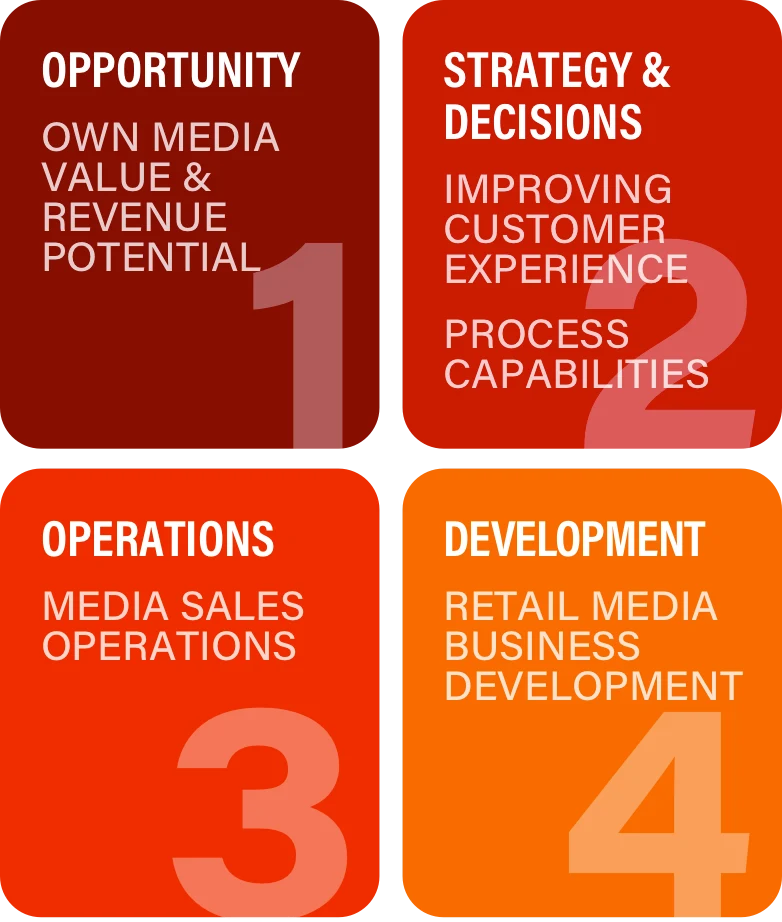
From a business perspective, fastest way to unlock the benefits of retail media and to explore the business case is to do it via experienced partner. There are so many business decisions to be made, regarding supplier models, customer experience, inventory management, sales processes, marketing to mention a few which requires expertise and experience from real live cases. Here is a typical “Becoming a retail media” path:
From a pure technology perspective, retail media requires tools that are specifically designed for this purpose. Using solutions that are not optimized for retail media means missing out on the full benefits of automation, efficiency, and scalability. Purpose-built platforms also ensure that your company is among the first to benefit from emerging technologies such as AI.
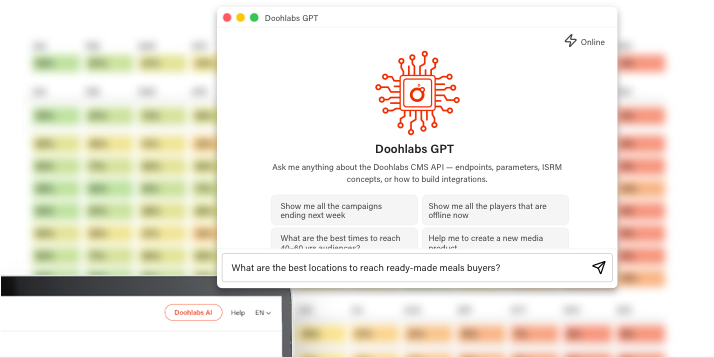
AI will play a central role in matching audiences with advertisers, monitoring network performance, optimizing revenue, and enabling systematic A/B testing of the right content across screens. In this rapidly evolving market, having the right technological foundation is not just an operational choice — it is a strategic one.
Hannaleena: With promising results in the Nordic market, I encourage every company to explore the opportunity to become a retail media. With a help of strategic partner, you will soon learn the potential there is to unlock - whether it is developing your current retail media set-up or building a whole new retail media revenue stream to fund your strategic investments or business areas.
Teemu: Technologies used to operate omnichannel retail media are multi-layered and deeply connected to the operational systems and data sources required to manage daily retail media sales. They must continuously evolve at the same pace as the surrounding business environment. Choosing the right partners is the safest way to ensure you stay aligned with the latest developments in retail media technology.
---

ReTALE is the leading e2e services provider in the retail media industry and innovator in the field, aiming for building open retail media networks and new revenue streams for B2C companies. Hannaleena works as a Senior Vice President in Aller Media Nordic. Her responsibility is the Nordic Retail Media Business and she has expertise in retail media from almost 10 years and years of experience from other executive level positions in the media industry. → www.retale.fi
Doohlabs is a retail media platform, specializing from 2019 to omnichannel and in-store retail media. Teemu is the Chief Growth Officer of Doohlabs, advising customers to grow their retail media businesses. → www.doohlabs.com
Craneworks is the leading builder of business critical in-store retail media networks. Craneworks provides its services for retailers and other consumer-facing businesses throughout the Nordics. Teemu is the Chairman of the Board in Craneworks. → www.craneworks.fi