Blog posts

Retailers have embraced data in demand forecasting and supply chain for years. If your company is selecting a digital signage or an in-store retail media CMS in 2026, make sure it natively understands data and can operate seamlessly in the AI world.
At Doohlabs, we see the next phase being shaped by microlocation intelligence. The goal isn’t to overwhelm teams with new complexity, but to introduce a gradual increase of intelligence that helps the same team operate a larger, more valuable network.
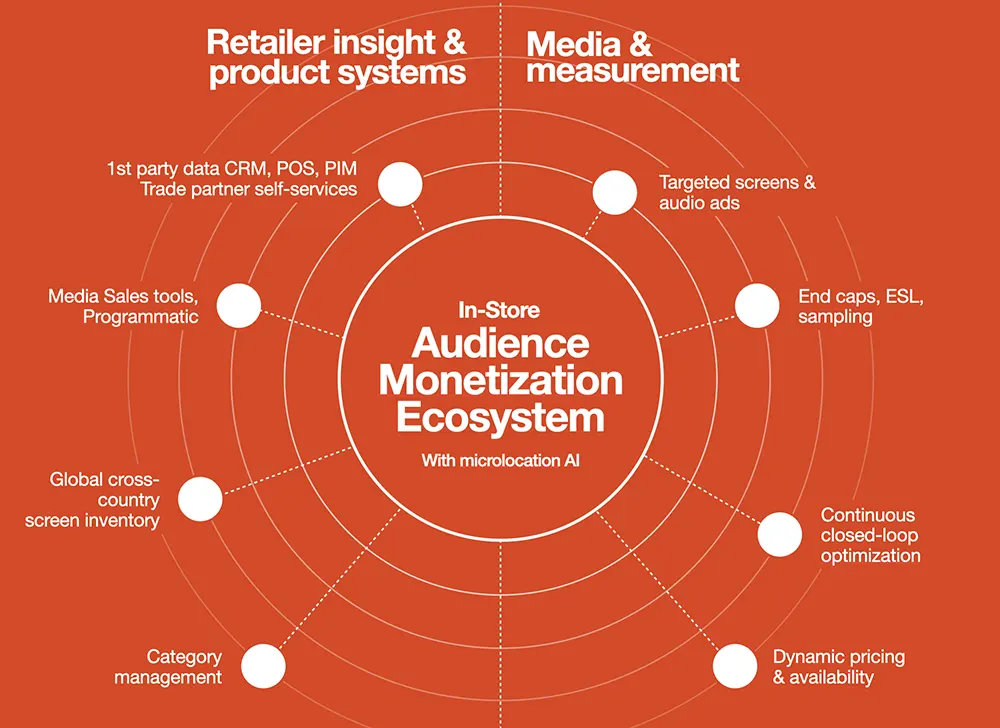
When screens become a monetizable channel, the expectation shifts toward audiences, measurable outcomes and retailer-grade governance while networks are getting larger and more fragmented—more stores, more screen types, more microlocations, and more stakeholders.
This is why “AI” in retail media should be approached less as a feature and more as an operating model.
The most valuable intelligence in-store is contextual and audience-related: Context accounts for where a screen is placed, what shoppers are doing around it, what category it influences, and how conditions change over time.
Audiences define trends targets groups for campaigns, enable razor-sharp targeting and eventually tell if the advertised product was bought but the people it was meant to or not. This is the foundation of the Doohlabs microlocation AI vision: optimize audience attributes, campaign structure, and targeted content at the individual screen level, and keep learning as the network runs.
In a nutshell, Doohlabs IMPACT in-store retail media platform is just another piece of the store infrastructure connected to other systems and catering the advanced operational, targeting and measurement needs of media sales to provide the unfair advantage compared to competing retailers.
Most retail media teams don’t lack data—they lack time. This is where a practical, gradual AI roadmap becomes strategically important.
The first step in a realistic AI journey is access. Most retail media teams already have data; what they lack is frictionless interaction with it.
That is why the first feature out is a conversational interface: Doohlabs GPT. It enables users to chat naturally about the status of media sales, screens, and the audiences reachable through the screen network.
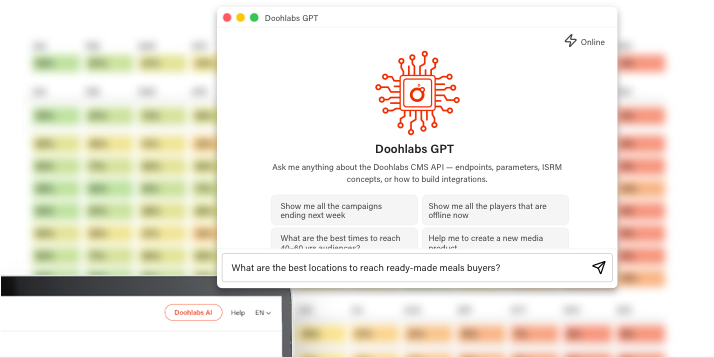
This matters because it changes the day-to-day operations: When insight retrieval becomes conversational, the platform reduces the need for specialized reporting skills, and routine questions stop consuming senior attention.
The next layer is microlocation intelligence that guides decisions with retailer reality in mind. The AI helps retailer to co-ordinate retail media operations on multiple levels, from GenAI-assisted audiences and campaign building to retailer and store-level recommendations, including guidance based on availability signals.
Retailers already know how powerful availability and category dynamics are. In-store is not a static media environment; it is a live commercial environment.
In-store is not a static media environment; it is a live commercial environment.
Recommendations that respect these realities (fex. in chains with thousands of individual stores) can prevent misalignment between what is being promoted and what is actually sensible to promote in a given store.
This is one of the most practical forms of AI: reducing the cognitive load of decisions that must be repeated across dozens or hundreds of locations.
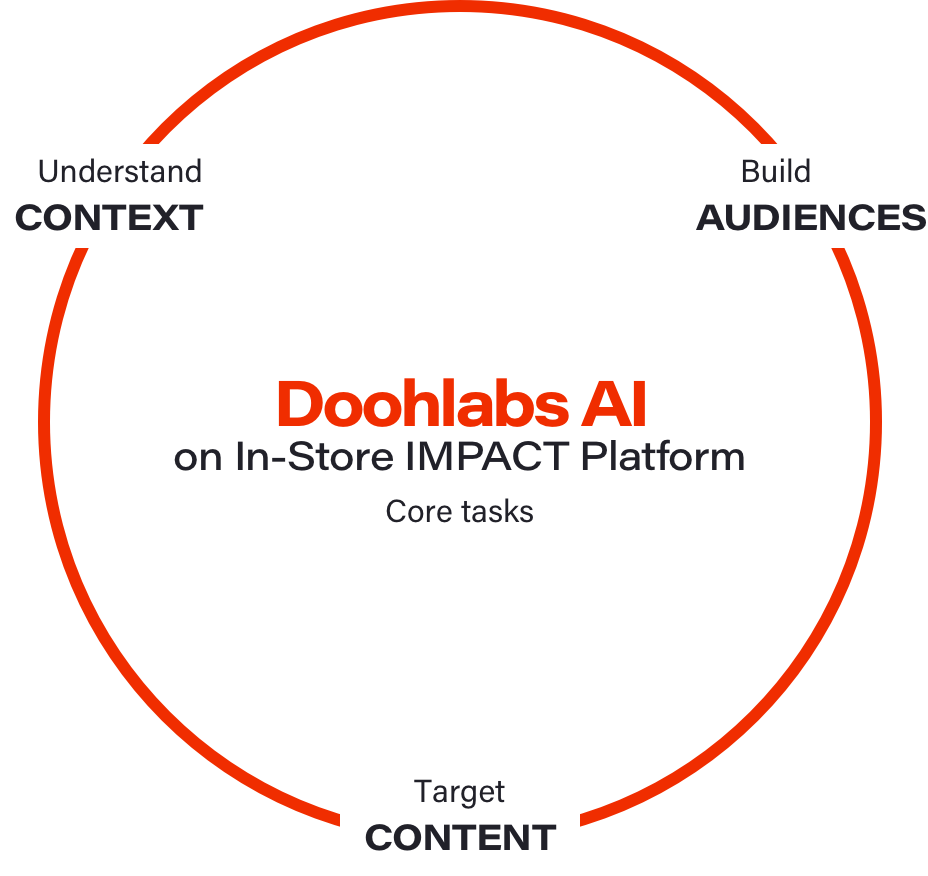
Creative variation is where many networks hit a wall. Brands want relevance and localization, but content teams cannot produce endless versions, and retailers must enforce guidelines and quality.
The Gen AI production concept addresses this by producing variants for text, video, and audio automatically across selected channels, guided by brand guidelines, audience attributes, and campaign structure, with the aim of delivering targeted content at screen level.
The operational significance is not “more content.” It is controllable scale. If variations can be produced within defined guardrails, retailers can increase relevance without turning every campaign into a custom production project.
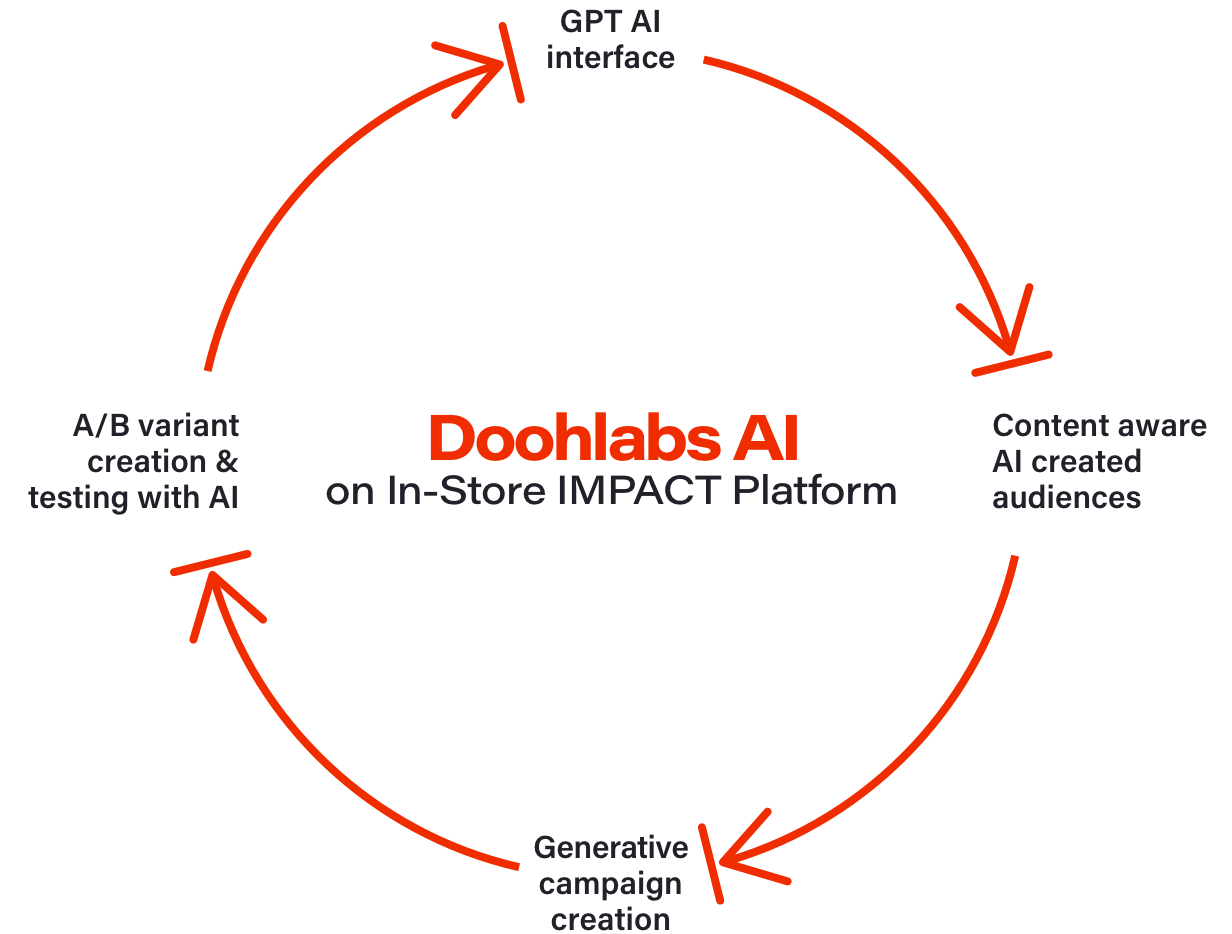
In this model, Doohlabs In-Store Impact is positioned as the operational layer where these decisions and outputs come together inside the retail media workflow, rather than as a disconnected experimentation lab.
Retailers have long understood that measurement is only valuable when it leads to better decisions. The microlocation signals, such as product category, screen size and angle, and current audience factors being used to generate variants, followed by continuous screen-level A/B testing and feedback matched with product or category sales data to improve future variants.
When testing and learning happens at the screen level, optimization becomes contextual. A network can learn which messages work best in specific microlocations and apply that learning automatically, rather than relying on manual experimentation cycles that few teams have time to run consistently.
All in all, retailers buying a In-Store Retail Media CMS today are not just selecting a tool for content distribution. They are selecting an operating system for a channel that will keep evolving.
Retailers do not experience value through features; they experience value through stable operations. When AI reduces firefighting and improves reliability, it directly supports commercial outcomes by ensuring campaigns run as intended and measurement remains trustworthy.
This is the approach outlined in our vision: start with conversational access through Doohlabs GPT, build toward recommendation and campaign-building assistance, expand into governed generative production, and evolve into closed-loop optimization at microlocation level.
As in-store retail media matures, the boundaries between media operations, retail data, and category realities will continue to blur. Platforms will connect audiences, measurement, product systems, and in-store touchpoints into a unified loop of planning, execution, and learning.
The 2026 In-Store retail media CMS decision should be treated as a strategic data decision.
That is why the 2026 CMS decision should be treated as a strategic data decision. The question is not only how well the system runs screens, but how well it understands the retail environment those screens live in—and how well it can operate in a world where AI becomes the standard interface for insight and action.
If you want to follow the development of practical, retailer-first intelligence in in-store retail media, explore more Doohlabs thought leadership and frameworks as we continue mapping what “AI-native” should mean in the store.