Blog posts

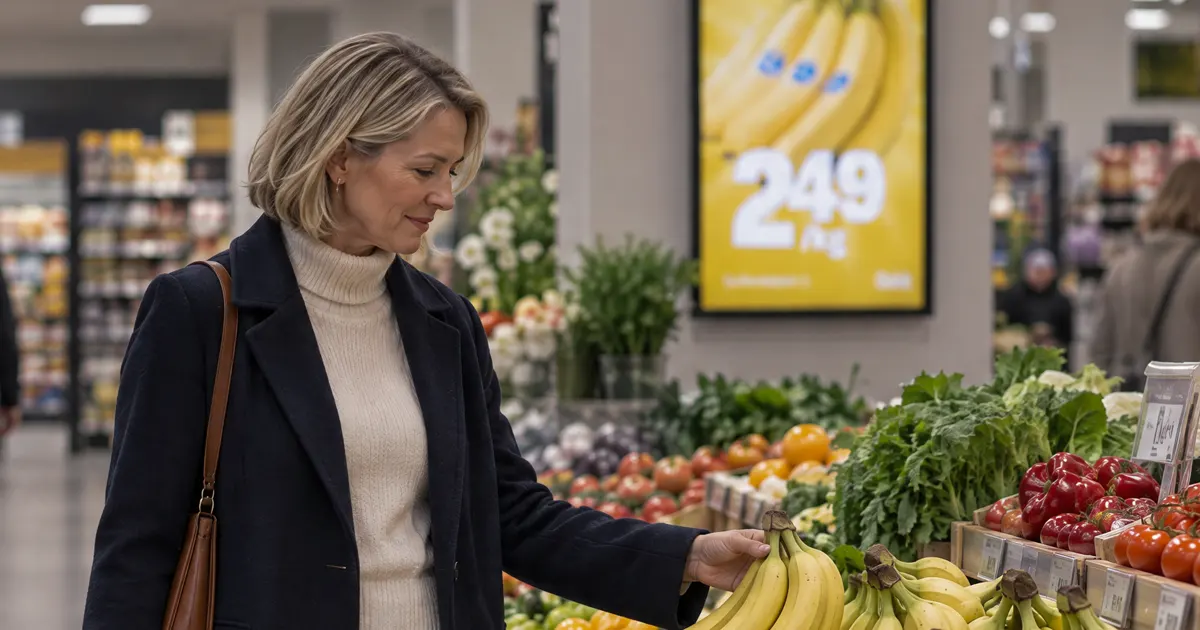
Walk into a large Finnish hypermarket on an ordinary Tuesday evening and start counting. For example, in S-Group's Prisma stores the average at the moment is about twenty screens: at the entrance, along the main aisle, at the end-caps, close to the dairy fridges. None of it surprises the people pushing their trolleys past. For Finnish shoppers this is simply what a supermarket looks like.ƒ
Across Europe, in-store retail media is talked about as the next frontier: the place where the last untapped budgets sit, still waiting to be built. In Finland it is a weekday routine. The screen networks of Finland's largest chains already stand comparison with those of any Central European retailer, even though Finland has far fewer people and far fewer stores. That gap, between what the rest of the market is planning and what one small Nordic country already runs, may be the best-kept secret in retail media.
Finland is a market of about five and a half million people with a language few outsiders read. Finns are not famous for announcing their achievements. And most of the networks were built before the vocabulary existed.
The shape of the market helped. Finnish grocery retail is fairly concentrated, and its leading groups have grown large enough to invest in their stores at national scale. A decision made at head office becomes a national network quickly. Finland is also a traditionally technology-friendly country: companies like to develop new things, and customers take them up quickly. Finns shop for groceries often too, which made the store a mass medium long before anyone sold it as one.
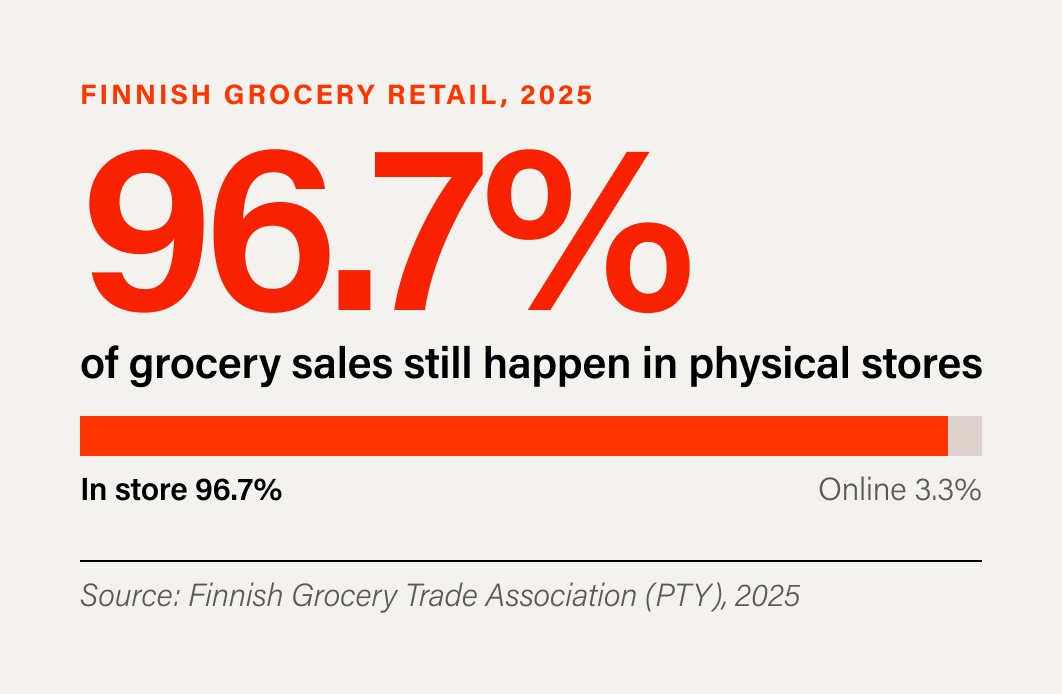
The store has also kept its place in Finns' lives. Online grocery has grown, but according to the Finnish Grocery Trade Association it still accounted for only 3.3 per cent of grocery sales in 2025, and across most of Europe the great majority of groceries are still bought in a physical store. People still want to go shopping, and Finnish retailers invest a great deal in making that visit a good experience. A store people like to visit is a store whose screens people actually see.
Early networks were built for the retailer's own communication: inspiration, news and offers along the shopping path. S-Group began bringing screens into its hypermarkets, supermarkets and neighbourhood stores across the country in the second half of the 2010s, years before most of Europe. Kesko had had displays already in many of their stores when they rolled out digital marketing screens in thousands in 2021. They called the result then as store media. Nobody yet spoke of a retail media network. Today each of the two runs a network that ranks among the largest in-store screen networks in Europe.
S-Group and Kesko were not alone. In parallel, service-station chains built sizeable screen networks of their own, and Veikkaus, Finland's state-owned gaming company, built a network of thousands of screens for its own needs inside retailers' stores. Many of these networks were not built with retail media in mind. But once a network is in place, the step to selling it as media is a short one, and service stations have been quick to take it. Others have followed. Tokmanni, the Nordic discount retailer whose range leans heavily on general merchandise, has built an in-store network across its stores, a sign that in-store media works well beyond the grocery aisle.
As the networks grew, retailers set up their own media units, such as S-Group's SOK Smart Marketing and Kesko's K Retail Media, and began to sell the store to brands as a channel. The media products followed the logic of the store, so a dairy brand appears by the dairy fridges and a drinks brand in the drinks aisle. In-store media also stopped being only about the offer of the week. By 2024 Finnish retailers were presenting campaigns that used it for brand building, and Kesko's retail media team spoke openly of an ambition to build “Europe's best retail media”.
Finnish retailers also began to measure their media and, unusually, to publish the results. S-Group's analysis of 51 in-store screen campaigns reported a median 8.3 per cent sales uplift for promoted products against the period before each campaign. Its 2026 recall measurements placed in-store screens among the top four channels in its attention benchmarks. Kesko worked with Aalto University School of Business in 2025 to ask media agencies what they want from retail media, and the answer was everyday reach and the moment of purchase.
There is a less visible reason why Finnish in-store media works, and it may matter most. Finnish retail chains understand their customers to a depth that is rare anywhere.
The structure explains part of it. Much of Finnish grocery retail is run either by co-operatives owned by the people who shop in them or by independent merchants who know their towns, their regulars and their busy hours personally. Understanding the customer is not a department in these businesses. It is the way they have always worked.
Both groups also run loyalty programmes that most Finns carry with them. S-Group has more than 2.7 million co-op members, and Kesko's K-Plussa has around 3.5 million members, covering some 90 per cent of Finnish households. Year after year, these programmes deepen how well the retailers know the people who shop with them.
That understanding is what makes a campaign in a Finnish store more than a slot on a screen. When a brand sits down with a Finnish retailer, the conversation quickly turns to which stores, which moment in the week, which part of the shopping trip and which message will actually move people. Retailer and advertiser plan the campaign together, and the result is better for both.
Screens can be bought and software can be licensed. What cannot be bought is the time it takes for an organisation to learn.
Finnish retailers have had that time. They have learned how content flows from head office to a single store, which screen positions earn attention and which only fill a wall, how to package and sell the media, and who inside the company owns the result. These are operating lessons, and every retailer starting a network today will have to learn them too.
Advertisers have learned alongside them. Finnish brands and their agencies have spent years briefing creative for a screen that a shopper passes in a few seconds, planning the store next to television and online, and expecting to see what a campaign did at the till. When a market's buyers have that much practice, the conversation moves on from whether in-store works to how to make the next campaign work better.
Retailers now starting out do not have to repeat every Finnish year. They can borrow the lessons.
Build a network the store itself needs. Finnish networks were first built for the retailers' own communication, and much of what runs on the screens is still the retailer's own content: offers, news, inspiration, seasonal campaigns. Automating that flow, so that the right content reaches the right store without hands on every screen, has been a large part of the success. A network the retailer depends on every day stays switched on and up to date, and that is what makes it worth buying.
Make someone own the media. The step from screens to a media business came when retailers set up their own media units with clear responsibility for products, sales and results. Without an owner, in-store media remains a side project of the marketing department.
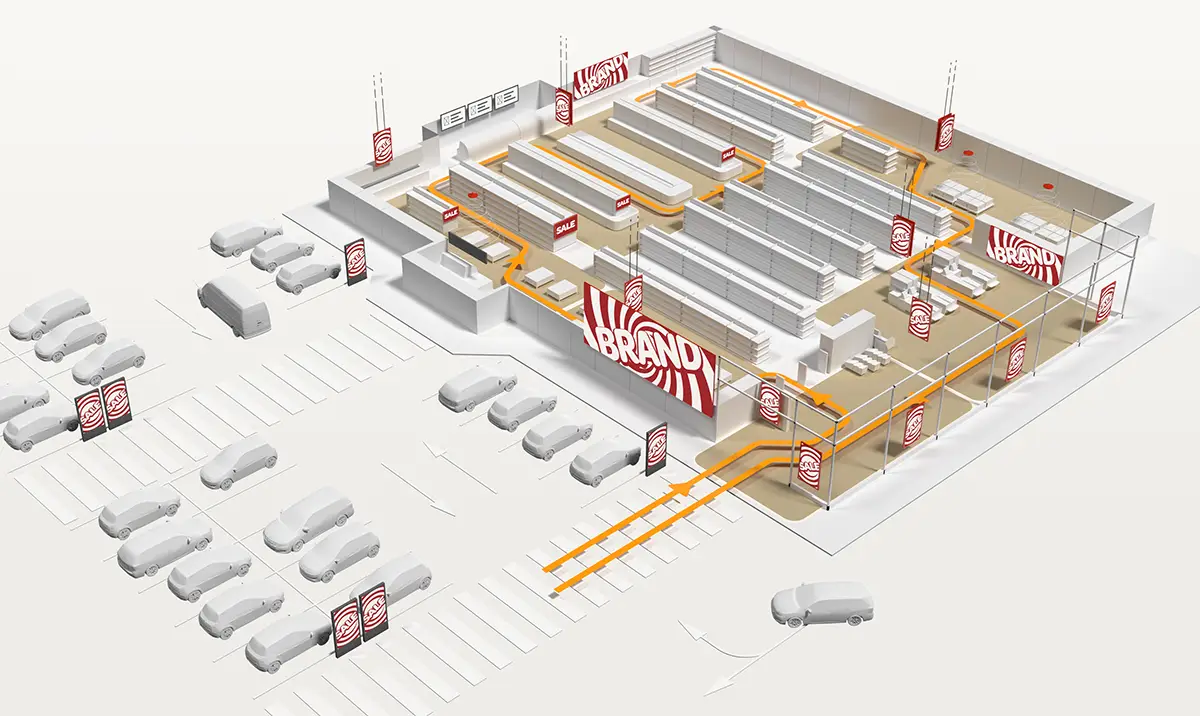
Design media around the store, not the screen. The products that work follow the logic of the shopping trip: the entrance for reach, the aisle for the category, the shelf for the final choice. Advertisers understand that kind of product at once.
Plan with advertisers, not for them. The retailer's knowledge of its customers is the most valuable thing it brings to a campaign. In Finland it is used when the campaign is planned, not only when it is reported.
Measure, and share what you learn. Finnish retailers have published sales and recall results and asked agencies openly what they need. That openness builds the advertiser confidence on which every media business depends.
Start now, because learning takes time. The Finnish advantage is not technology. It is years of practice, and the only way to get that is to begin. Retailers and station networks that already have screens are closer to retail media than they may think.
Finland's retailers and advertisers have already done much of the learning, and the rest of the world does not have to start from zero. The best way to understand it is to see it. Come to Finland, walk into a few stores on an ordinary weekday evening and count the screens between the door and the till.
The know-how has built up on the supplier side too. Doohlabs has developed its in-store retail media platform since 2019 and today sells it to retailers around the world. In 2025 SPAR International chose Doohlabs as its global preferred platform partner for in-store retail media. Its sister company Craneworks brings long experience of building and running business-critical screen networks, and is now taking that experience across the Nordics.