Blog posts


Many of Europe’s discounters fit neither. Most of what is on their shelves is their own brand, and some have decided that they do not need a loyalty programme at all. So they are usually treated as the place where retail media does not quite work.
We think that reading has the order backwards. The most important ingredient of an in-store audience is not the loyalty card. It is the receipt, and these retailers have every single one of them.
Look at what sets discounters apart and price turns out to be only the surface. What matters for retail media is how much of the shelf belongs to the retailer: a hard discounter carries far fewer products than a conventional supermarket, and the large majority of them are its own brand.
"Discounter" names a price position. For retail media, the trait that matters is ownership of the shelf, and it reaches beyond discount: Mercadona in Spain runs on its own brands and everyday low prices without calling itself a discounter at all. And the trait is spreading. NielsenIQ data published by PLMA puts private label at 38.8% of grocery value across 17 European markets in 2025, growing faster than the market and above 50% in Switzerland. Even Carrefour plans for its own brands to reach around 40% of food sales this year.
Retail media grew up on the opposite model: many brands per category, each with a budget, competing at the shelf. Each time a grocer replaces a branded product with its own label, it loses a potential advertiser: no supplier pays to promote a product that carries the retailer's name. Discounters are where the whole industry is heading, just further along. If retail media cannot work for them, it has a problem everywhere.
An in-store audience is built from what people buy, where and when. The till records every basket in every store at every hour: what sells at 8am in a commuter location, what weekend families put in the trolley. Grouped into patterns, that becomes something an advertiser can buy: families shopping the breakfast category on weekend mornings, in these 120 stores. The pattern is the product.
Loyalty data is valuable, but it does a different job. It adds identity across visits (households, frequency, who is new to a brand) and personal channels such as an app or email. It sharpens audiences and carries them into owned digital channels. It is not what makes them possible. A loyalty scheme covers its members' baskets; the till covers everyone's.
Discounters already show both routes on the same base. Lidl has built its Lidl Plus app to more than 120 million users in 32 countries. Many others have chosen not to run a loyalty programme at all, so that the shelf price applies to everyone with nothing to activate. Either way, every receipt is there. One route adds a layer on top; neither lacks the foundation.
Discounters often sell simplicity: one price on the shelf, nothing to activate, nothing to unlock.
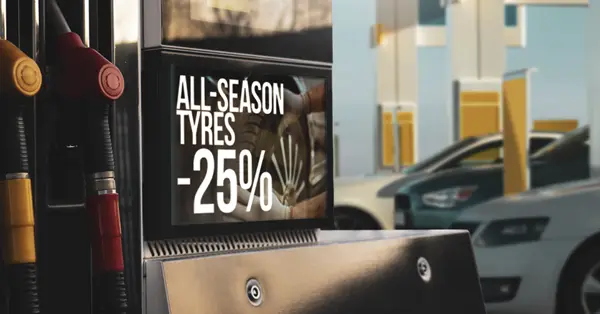
A screen in a discounter store does that too. Everyone passing the entrance at 8am sees the same message, chosen because of what that store's shoppers tend to buy at that hour. Targeting happens at the level of store, time and category, never the person. In-store media is contextual by nature, needs no personal data and never puts two prices on the same product. Of all retail media channels, it is the one that fits the discounter model.
It also fits where these retailers do business. For them the store is not one channel among several; it is close to the whole relationship. When nearly every customer relationship happens in the store, the store is where the audience is. Omnichannel, for them, starts there and grows outwards.

The obvious objection is commercial: if most of the shelf is own label, who buys the media? The answer comes in an order, and the order matters.
The first advertiser is the retailer itself. Discounters run a heavy promotional calendar of their own: weekly specials, seasonal non-food ranges, own-label launches, store services. Automation turns that from a manual chore into the network's first return. Content is generated from product and price data and reaches the right stores on time, with the right price.
The same receipts that build audiences for brands decide where and when each own-label message runs: the ready meal before lunch in commuter stores, the barbecue range on the first warm weekend, targeted by store, hour and category. And because every promotion is read against the sales it was meant to move, targeting improves itself, shifting airtime towards the contexts where a promotion sells and away from those where it does not. That is why the screens can pay their own rent before a single outside campaign is sold.
The second is the brands they do carry. On a shelf with few branded products, a brand's message does not compete with five rivals. Scarce, uncluttered attention is worth more per slot, not less.
The third, in order though not in size, is advertisers who do not sell on the shelf at all: insurance, telecoms, energy, banking, travel, public campaigns. This is not a remainder. Many of these retailers gather giant audiences. Lidl for example runs some 12,900 stores in 32 countries; Biedronka has more than 3,500 in Poland. Week after week those stores see households across every life stage, and for non-endemic advertisers that reach is worth a great deal. And the store delivers that reach in an uncluttered environment, at the moment household money is being spent. Selling to them is media sales work, best done with a partner who already knows those advertisers.
The second objection is measurement: without loyalty IDs, how do you prove a campaign worked? The same way retailers already judge their own promotions, by comparing stores. A campaign runs in one group of stores and not in a matched group, and the receipts show the difference.
EDEKA reported that an in-store screen campaign for Rügenwalder Mühle in around 150 stores lifted sales 42% above comparable stores that did not run it (EDEKA's own figure). In France, the screen network Carrefour is rolling out across 700 Carrefour Market supermarkets uses aggregated, anonymised sales data both to steer delivery by store, category and trading peak and to measure the effect on real sales, formally excluding any personal loyalty-card data.
The receipt does both jobs: it builds the audience before the campaign and proves the result after it.
Discounters are also unusually standard. Store layouts repeat across thousands of sites, so a media product can be defined once and sold everywhere. The positions that matter are the same in every store: the entrance, the main customer route, the key end-caps where the week's promotions stand, and the checkout.
Each has its own job, and together they follow the shopper through the whole visit instead of greeting her once at the door. And because own-label promotion fills most of the airtime, the network has to be wired into product and price data from day one. A discounter store is in a perfect position to build a optimal retail media messaging network around the designed customer paths in their highly formatted stores.
The industry tends to treat discounters as retail media's hard case: too few brands, no loyalty data, little appetite for complexity. Look again and they are its clearest case. Nothing stands between the receipt and the audience, the store is where the customer relationship lives, and the business case can start with the retailer's own promotions before it needs a single outside advertiser.
As private label keeps gaining share, every grocer will face a smaller pool of brands on its own shelves. The discounters will have worked out the answer first: start with the receipt, keep the same price and the same screen for everyone, and add the rest when it earns its place.
How to build an in-store network from the store outwards is covered in our 2026 In-Store Retail Media Playbook, Store in the Core.