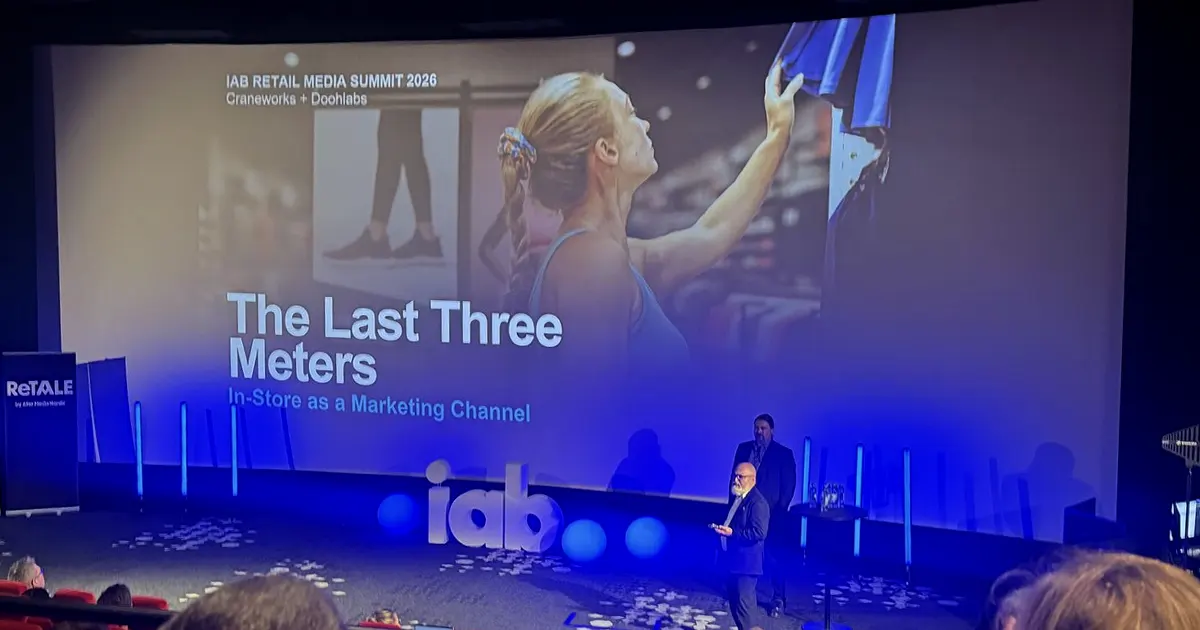
On 2 September, several hundred retailers, media owners, agencies and brands filed past the popcorn counters of Finnkino’s movie theatre Tennispalatsi in central Helsinki, took their seats in the dark, and spent the day with interesting retail media presentations and dialogue. The IAB Retail Media Summit 2026, hosted by IAB Finland with SOK Smart Marketing and ReTALE by Aller Media Nordic, has become the largest retail media gathering in the country, and this year's edition had the feel of an industry that has stopped introducing itself.
In the middle of that afternoon, Janne Lohvansuu of Doohlabs and Sami Käyhkö of Craneworks stood up to talk about the one place almost every retail media conversation in Europe still skirts around: the store itself.
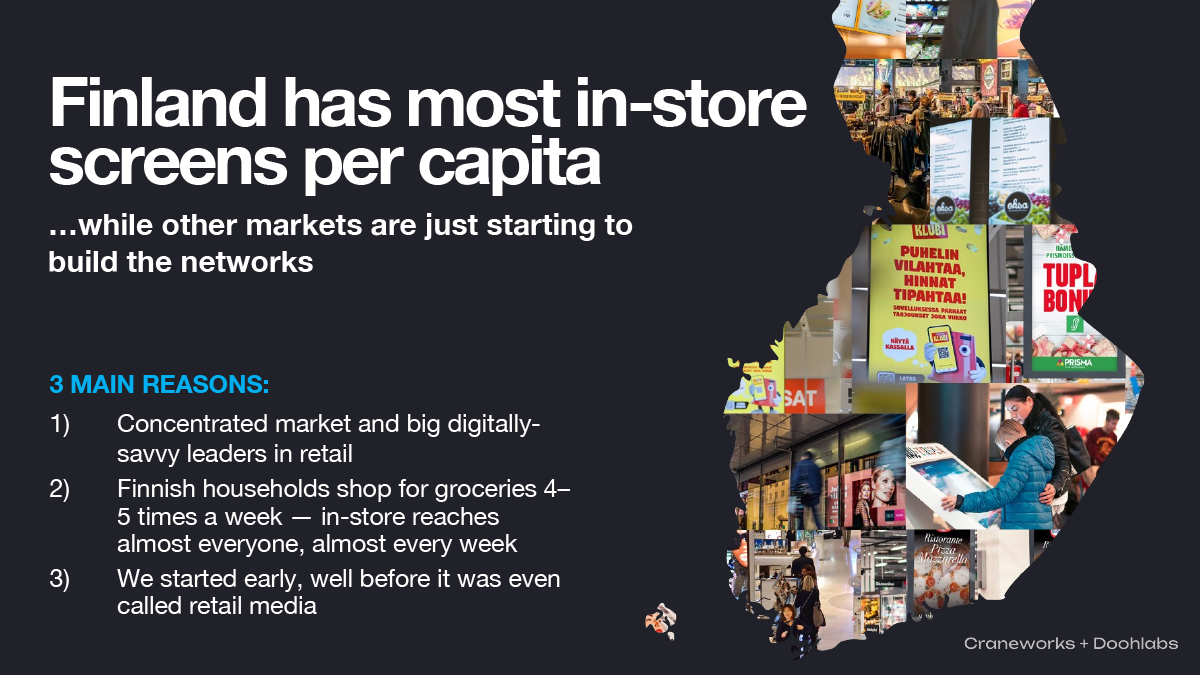
Their opening claim tends to raise eyebrows abroad. Finland — five and a half million people at the edge of Europe — has more in-store retail media screens per capita than any market we know of.
The explanation is actually less dramatic than it sounds, and that is precisely why it travels. Finnish retail is unusually concentrated and led by large, digitally confident groups, so a decision taken at head office can be standing in hundreds of stores within a season. Finns also shop for groceries four or five times a week, which makes the supermarket the most frequent media touchpoint in most people's lives. And the networks were built early — well before anyone called them retail media, when they were simply digital signage and nobody yet knew what the screens would be worth.
The result is a country that has already made the mistakes other markets are about to make. That is what Janne and Sami had come to share, organised around the distance a shopper covers in the final seconds before a purchase.
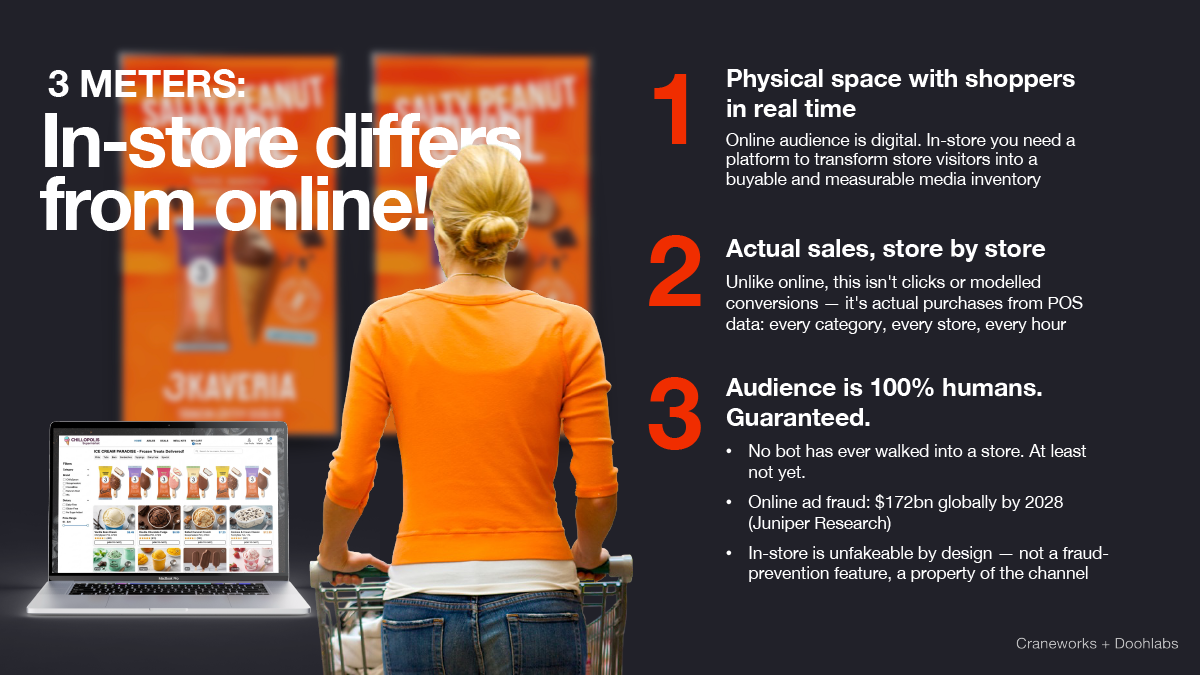
The most common error in retail media, they argued, is to treat the store as a large, slightly inconvenient web page. At three metres from the shelf, that assumption falls apart.
Online, the audience arrives already digitised, wrapped in cookies and identifiers. In a store, the audience is a real shopper, and unless someone has built the machinery to turn her presence into inventory that can be planned, bought and measured, she is not a media audience at all — she is just a shopper. Online, results are clicks and modelled conversions. In-store, the result is a purchase logged at the till, by category, by store, by hour, in a dataset the retailer already owns.
And then there is the point that drew the warmest response of the session. No bot has ever walked into a supermarket. Juniper Research expects online ad fraud to reach 172 billion dollars a year by 2028; in-store, fraud is not something you prevent, it is something the channel is physically incapable of. An audience that is one hundred percent human is not a feature. It is a property of the room.
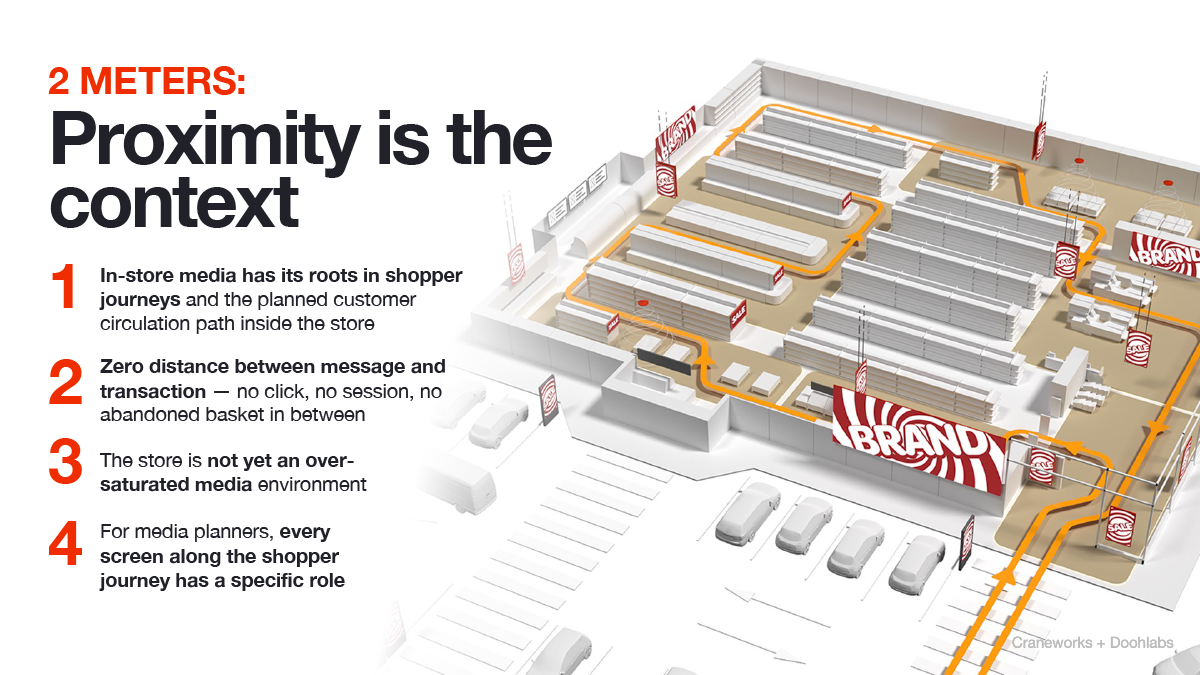
Closer still, and the conversation turns from what the channel is to how it should be planned. Every store is laid out as a route — a circulation path that retail planners have been refining for a century — and in-store media inherits that logic whether or not the media planner notices. There is no gap between message and transaction here: no click, no session, no abandoned basket in a tab somewhere. The message and the money share the same aisle.
It is also one of the few environments a planner will encounter that is not yet saturated with advertising — which makes it all the more wasteful to buy as an undifferentiated block. The screens at the entrance introduce a brand to every person who walks in. The screens along the main aisle keep it company down the primary route. The end-cap is where a brand wins its category, and the shelf-edge is where it wins the moment of choice. Four positions, four jobs, and a planning discipline that owes more to store design than to programmatic display.
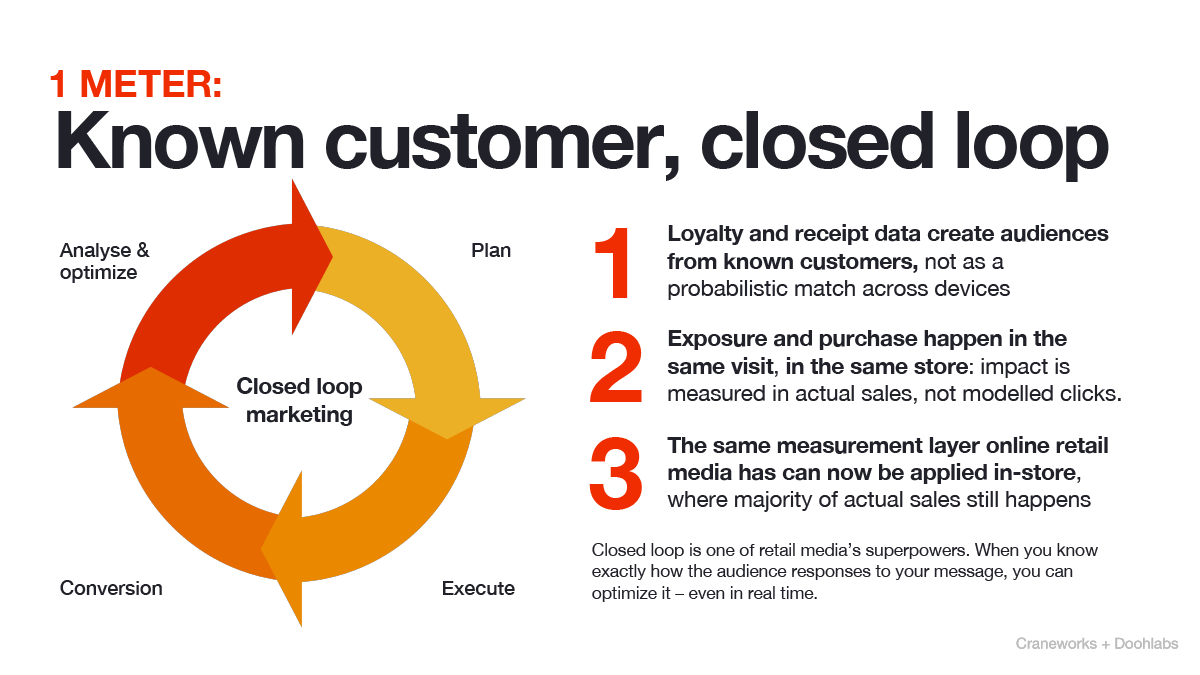
The final metre is where the argument stopped being about screens and became about data. Retail media earned its budget online by promising a closed loop: show an ad, see the sale. In-store, that loop is not only possible but tighter, because exposure and purchase happen in the same visit, in the same building, minutes apart. Loyalty and receipt data build audiences out of known customers rather than probabilistic matches across devices, and impact is read in actual sales, not modelled ones.
The measurement layer that made online retail media respectable to brand marketers can now be pointed at the place where most of the money still changes hands — and when a planner knows how an audience responded, the message can be adjusted while the campaign is still running.
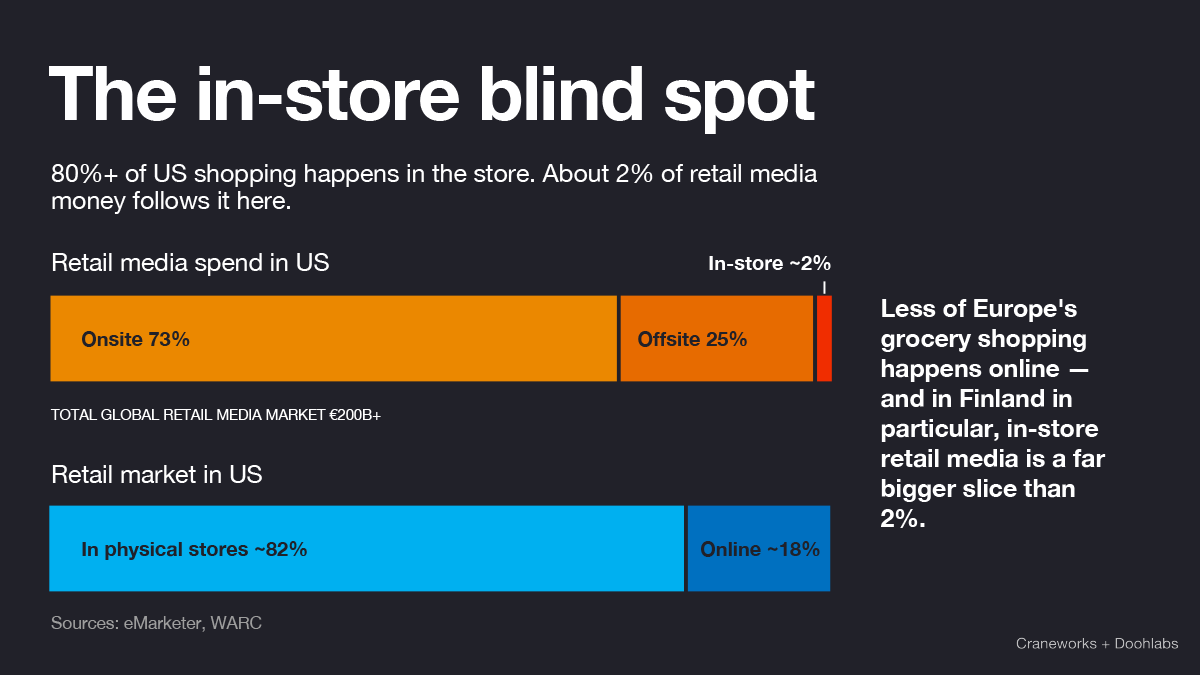
Then came the chart that quietly makes the case for the whole session. In the United States, more than eighty percent of shopping still happens in physical stores. According to eMarketer and WARC, roughly two percent of retail media spend follows it there; the rest is split between onsite and offsite digital. Europe's grocery market is far less online than America's, and Finland's less still, so the in-store slice here is already considerably fatter. But the gap between where people actually buy and where the media money goes is the same on both sides of the Atlantic, and it is the largest unresolved imbalance in the industry.
Three things, delivered plainly. In retail media, in-store typically reaches far more people than online. In-store retail media is only getting started, and there is a great deal of room to grow. And in the end it is the data, not the glass, that makes the store an unbeatable marketing channel.
For Doohlabs, that conviction is what In-Store IMPACT was built to serve: audiences created from retailer data, media sales tools that let a network actually be bought, and campaign management with delivery and measurement in one place. For Craneworks, it is the reason the screens went up in the first place. The two companies have spent the better part of a decade finding out what the last three metres are worth. Judging by the conversations afterwards in the cinema lobby, the rest of the industry is ready to find out too.
---
Janne Lohvansuu is CEO of Doohlabs. Sami Käyhkö is CEO of Craneworks, Doohlabs’ sister company and a full-service partner for in-store retail media networks in the Nordics and the Baltics. The IAB Retail Media Summit 2026 was held on 2 September 2026 at Finnkino Tennispalatsi, Helsinki.


